A cloned CEO, a fake law firm, $129M wired
For two years, one crew cloned executives and their lawyers to pull money out of banks, hospitals and fund managers.
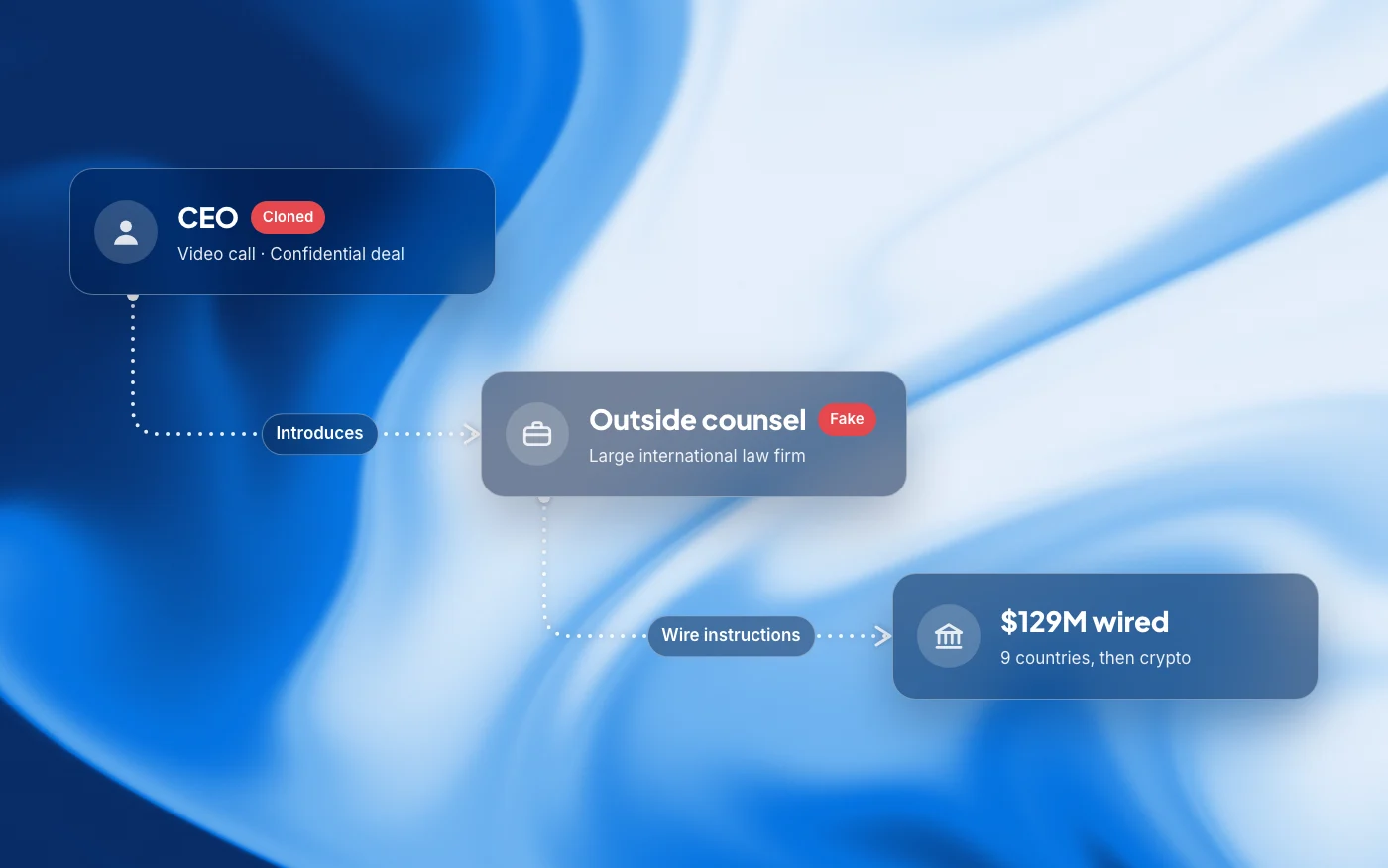
On 5 November, the US Attorney's Office for the Southern District of New York charged three men, Jacob Soall, Sharon Hazan and Guy Sheetrit, over a deepfake fraud that took at least $129 million from companies around the world. From 2024 to 2026, prosecutors say, the crew cloned the voices, and sometimes the faces, of CEOs, posed as lawyers at major law firms, and used both to get employees to wire money. The charges are allegations, and the three men are presumed innocent unless and until proven guilty.
How the scam worked
Two fake people, each confirming the other.
- —The CEO. An employee gets a call from their chief executive about a confidential deal. The voice, and sometimes the face, is an AI clone.
- —The lawyer. The "CEO" tells the employee to work with lawyers at a large international law firm on the deal. The lawyers are fake too.
- —The wire. A fake lawyer sends the payment instruction. The money lands in accounts in the US, Spain, Portugal, Greece, the UAE, Singapore, Austria, Slovakia and China, and is turned into crypto.
According to the indictment, Soall kept a handwritten script titled "Lawyer Call". Part of it was written to stop employees talking to their colleagues.
Who was hit
The charging documents describe the victims without naming them. Six of them:
| Victim | Location | Amount |
|---|---|---|
| Financial technology company | United Kingdom | $11,578,474 |
| Pet food company | Florida | $5,242,747 |
| Hospital system | Missouri | $4,829,580 |
| Mutual fund company | Massachusetts | $4,639,918 |
| Hospital system | California | $2,968,497 |
| Bank | Rhode Island | $2,684,580 |
A bank and a fund manager are on the list. These are organisations with payment controls, and the controls were talked around.
Why it worked
The cloned CEO made the first call believable. The fake lawyer closed it. The employee did check the deal, with a lawyer the CEO had supplied. Every check stayed inside the attackers' story, and the secrecy kept anyone else from looking.
The same play hit Fideuram, part of Intesa Sanpaolo, this year: a fake CEO, a cloned lawyer on a confirming call, a confidential deal and €95 million wired. The technology is new. The method is old: authority, urgency and secrecy, delivered in a voice you trust.
What finance teams can do
- 01Treat any request to keep a payment confidential as a reason to escalate.
- 02Call back on a number from your own directory, never one in the message or given on the call.
- 03Verify outside counsel yourself. A lawyer introduced by the caller is part of the same request.
- 04Require two approvers for large or unusual wires.
- 05Hold new beneficiary accounts, especially overseas, until they are confirmed through a known channel.